Wednesday, November 18, 2015

Sadness

This is the second installment of this blog entry.  The original is still unchanged below.  Unfortunately we are still encountering Americans making asses of themselves on the news over here.  I hate being embarrassed for my country.  



Please take 5 minutes sometime during this long weekend to reach out to your political representatives.  If you don't tell them differently, then they will continue to believe they are doing what you want and our country will continue to make the problem worse!   

Your email would represent a hundred people in their minds because these guys hear from so few voters that they will assume it's important if you take the 5 minutes out of your day to send a note. 

Here's an example of what I sent my representatives:

Dear Sir,

I am a voter from your district in Houston and am writing to tell you that I support continuing to allow Syrian refugees to enter our country using the existing screening process.  I also want our country to be safe, but do not agree with your recent positions on refugees.   
It is my understanding that the Paris bombings were organized and perpetrated mostly by French citizens born in France and then radicalized by by the Islamic State.  I think your current rhetoric actually helps the radicalization of Muslim citizens.  Please stop resisting refugees or implying that they are Muslims are less important than Christians.  It is making our country less safe, and is not very Christian.


Texas governor

Find your congressman

Texas Senators

http://www.cruz.senate.gov/?p=email_senator   But I don't think Cruz will listen.

**************************************************************
The original blog post on November 18th

I hope you will share this.  Hopefully you don't share this post because I am not a great writer . . . but I hope you will discuss the sentiment with others, including maybe even your government representatives who are behaving like asses.  

A tragedy happened in Paris the same night I arrived in Istanbul.  And it is with great sadness that I am watching my country react based on fear instead of intelligence.    

There are a few things that folks in the US seem to be missing, like the facts:  
- All but one of the kamikazes currently identified in Paris were home grown.  They were born in France and the French speaking part of Belgium.  --update: it is now all but 2.  The Syrian passport was confirmed to be a fake over a week ago, but the person did enter Europe using the refugee process.  Little more is known about him.
- These kamikazes could and did re-enter their home countries without a refugee title.  
- The director of the operation was also home grown.  

So it boggles my mind to hear politicians and common people declare we should not accept refugees.  This reaction is not only uneducated, but the rhetoric is actually making the problem worse.  The terrorist attacks are not a refugee problem.  The refugee problem is that there are millions of families who have fled for their lives and have nowhere to go.  


I know it's scary times.  I'm scared too.  The thought of people willing to kill themselves in order to hurt innocent people is terrifying.  The wave of bomb threats after this attack is scary.  But there are other, better ways to respond than trying to keep innocent people out of our country.  Letting kids grow up in tent camps will not make us safer. The Islamic State says their goal is to generate fear and chaos.  They are winning right now because we are letting them.

Sunday, November 15, 2015

Food Tour of Emelia Romagna - epicenter of food in Itlay

I only had one real day in Italy before flying to Turkey, and I made the most of it by getting a food tour of the Emelia-Romagna region located halfway between Milan and Bologna.


You've heard of it.  It's where Parmesan is made, Parma Ham is produced, Balsamic Vinegar was invented (and then bastardized for wider usage) and many a bottle of wine is still lovingly bottled.  I learned it's also the home base for the food authorities of the European Union - do you need any further proof that it is the center of a food universe and foodie paradise?

I rented a car and booked a tour where I ended up joining a Quebequoise family for the day.  They were lovely.  Angelo was our tour guide for the day and I cannot sing his praises loudly enough.  If you're ever in Italy, look this guy up!  He is a local but travels widely around the world and speaks flawless English.  Angelo rode with me, which means I almost got a private tour.  

Parmesan must be aged for
a minimum of 1 year
The first stop was a Parmesan cheese factory. I will spare you all the details, but you can probably guess that I really enjoyed this part of our tour.   I was constantly comparing and contrasting to the farm where I just came from.  This was still artisan production but slightly more commercialized than the very mom-and-pop shop at Roquecave.
If you want real Parmesan, you
have to buy the stuff that still
shows "Parmesan" imprinted
on the rind.
Everything else is an imitation.

This factory is a co-op with the dairy farmers who provide milk.  The cheese making process significantly upgrades the value of their milk, and they get a cut of the proceeds.   In return, the dairy farmers are required by Italian law to limit the food for their cows to all-natural, locally sourced grains, hay and grass.  They are not allowed to use hormones or antibiotics.  Anything else will disqualify the cheese from receiving the coveted DOG Parmesan label.  Unlike the French family at Roquecave, these guys don't get a break in the winter because cows produce milk year round.  So they make cheese starting at 8AM, 365 days a year, rain or shine, including Christmas and New Years. 

The process starts after the cheese has formed and the curd and whey have separated.  The cheese master is cutting the cheese in this video.  He's using an ancient tool to do it, and periodically checking the consistency of the "grains" of cheese curd that will now settle to the bottom of the copper basin.


Then the cheese makers pry the settled ball of cheese out of the bottom of the basin, into a cheese cloth. 


Then they cut the ball of cheese into 2 pieces, which happens to be the perfect size to press into the big wheels of Parmesan.


The Parmesan is dried for a couple of days to firm up the wheels, salted via a salt bath for 25-30 days, and aged for a minimum of 1 year before it's tested to determine if the quality is high enough to be labeled Parmesan.  Europeans enjoy Parmesan that is aged for 2 or 3 years, which makes it nuttier and more flavorful.  Our government only allows the 1 year old version to come to America.

Angelo describing the aging Parma
Ham on the top floor of the factory.
This room smelled heavenly.
Next stop was the Parma Ham factory.  We climbed up into the mountains for this one - apparently the altitude and temperature matters for the processing of the ham.  Here again, nothing is wasted.  The nutrient-rich leftover whey from the Parmesan cheese makers is given to the pigs that ultimately turn into the succulent, paper-thin sliced Parma Ham we love to eat.

Some of this process just
cannot be automated,
despite best efforts
More than a year after starting,
This is how you know it
is authentic Parma Ham


Like the cows supplying the Parmesan factory, the pigs supplying the Parma Ham factory are on a very strict, organic and local diet.  The traditions for making this ham date back for centuries and have been institutionalized by law now.  Angelo declared the only ingredients allowed in Parma ham are: pig, salt, air and time.  The only concession producers have made to modern times is that they now use climate controlled (ie refrigerated) rooms to store the ham during the salting and initial drying phases.  This change was made after WWII, and it is still mildly scandalous that they have deviated from tradition. Parma Ham, like Parmesan, must be aged for at least a year before it is allowed to be quality tested and branded with the Parma DOG symbol.

The next stop was a trattoria up the street from the Parma Ham factory, where I had some of the best pasta I've ever tasted.  Angelo brings people to this place because it's also his favorite place for pasta. 

The view from the foot of the road leading to the factory
The Langhirano region is beautiful.
The last stop was a visit to a traditional Balsamic Vinegar producer.  The balsalmic that you buy off the shelf is actually a version invented recently down the road in Modena.  It was invented because it is impossible to mass produce the traditional stuff.  The stuff you buy in grocery stores takes a lot of the flavors you would get if you tasted the original Balsalmic and mix them into wine vinegar: Voila!  Balsamic vinegar that you can actually afford to put in salad dressings and pour over vegetables around the world.  

It's not an optical allusion
The barrels get smaller in a set
The traditional stuff is actually cooked grape juice that is fermented for years to achieve that sweet, slightly tangy flavor.  They put the juice in the 1st barrel of a "set" to let some of the liquid evaporate off during the warmer summer months and then ferment during the cooler winter months.  Then they transfer the remaining liquid to the next, smaller barrel in the set.  Repeat this process every year for 5-20 years.  It's a chemical engineer's challenge:  How do you speed up a process that requires cyclic evaporation and fermentation stages while imbuing the liquid with flavors from the barrels of oak, cherry, chestnut or other woods?  Surely there has to be a way to make this go faster.


I am glad that I like, but don't love the traditional Balsalmic.  It is $50-150 per 3oz bottle and would be an expensive habit to form.


It was a great day spent in Italy.  I ate so well that I voluntarily skipped dinner that night and just packed up my stuff for my flight out of Bologna early the next morning.

Next stop: Turkey


Adventures in foreign languages

A while back, I booked my ticket to Istanbul from Bologna, Italy.  I will meet my cousin, Andrew there.  At the time that I booked my flight, it wasn't clear how long I would stay in France before wandering over to Italy.  I ultimately decided to stay as long as possible at Roquecave while still comfortably make my flight.  The trip from the tiny French farm to the airport in Bologna would take me a day and a half and involve 5 different buses and trains and even a car.  I ended up making it to Milan after one 14 hour day of travel, and having a day in Italy to spend as I pleased.  

There were a few mini-adventures in Milan that probably interest nobody but I’m going to blog about one of them because it is so stereotypical of my foreign travel: my adventure at the post office. 

Background:

Milan was my only shot to take care of a few things needed to be done before hopping on a plane.  I had a couple of hours before I needed to be at the train station to get all the errands done.  My last stop was the post office.  I wanted to mail some things home that were taking up unnecessary space in my backpack/suitcase but I didn't know how much it would cost.  If it turned out to be too expensive, I intended to bite the bullet and keep hauling them around.

Keep in mind that I speak absolutely zero Italian.  I speak French and English and just started learning Spanish online.  

Adventure in a foreign language:

I found the post office by asking the lady behind the bakery counter where I grabbed breakfast for directions.  She didn't speak any English, but . . . when said quickly, the first two syllables of Post-off-ice sounds enough like Posta--fice.  So she recognized "Posta", the Italian word for post office :)  Her gestures for turn left and turn right coupled with names of streets were enough to get me there with only one wrong turn.

I nosed my way into the post office and didn't see any boxes for sale.  Drat.  I needed packing materials.  Then I remembered I had seen a grocery store next door to the post office. . . So I waltzed into the Carrefour intending to look for supplies.  I was early enough in the morning that they were still stocking the shelves - bingo!  I had my choice of boxes.  A quick run back to the hotel to grab all the stuff I wanted to mail, and the front desk happened to have a roll of packing tape that the let me take with me.  I was set.

I head back to the Post Office carrying my box full of stuff and feeling fairly resourceful at this point.  Unfortunately, when I got to the counter, the lady behind it did not speak any English.  None.  Zip. Zero. 

Our exchange looked something like this

  • She rattled off a lot of Italian questions that I did not understand a word of. 
  • "Is English OK?"
  • Shaking of the head.  No, sorry, no English
  • More rapid fire Italian questions.
  • I gesture to the box in front of me. 
  • She asked another question in Italian. 
  • I look at her helplessly, and simply answer “Texas.”
  • This makes her laugh and she asks another question in Italian, this time with hand gestures that look like an airplane. 
  • I shake my head and say the word for “cheap” in English and French.  This makes her look puzzled.
  • "Economico?"
  • "Si!!" 
  • She starts typing furiously into her computer, takes my box and puts it on the scale. This is promising.
  • She turns the computer screen towards me and points to the figure, “Quatro-something something???”  [The questionmarks are audible]
  • "Yes!  That price is OK."
  • A quick nod from the lady and she takes my tape from me, and in an exaggerated way, starts to tape over the markings on the box from the bread company that used it first.  She is still talking in rapid fire Italian.
  • I do not understand her words, but I do comprehend from her actions and finger pointing that all the markings on the box need to be covered up.  I can do that.  It will take a lot of the hotel’s tape.  I nod to indicate that I understand.
  • Then she hands me two pieces of paper to fill out and slowly explains them to me, or at least tries to.  I understand only her explanations for “To” and “From” because they are the same words in French. 
  • I get a lucky break:  The papers turn out to be an address form with carbon copies and a customs form and happen to have the boxes labeled in both Italian and French (don’t ask me why, because that makes no sense to me!)  It allows me to successfully fill in the paperwork, using the instructions in French.
  • I return to the counter with the paperwork and a box almost covered in tape.  
  • She looks curiously at the blank address for the Sender (me) and says something in Italian while shaking her head.   I understand that no return address is somehow a bad thing.
  • I look helpless again and say “vacation”  It’s the same word in French.
  • She asks me another question in Italian that I do not understand.
  • I hold up a finger – "Wait!  Can you use the hotel’s address?"  I show her the address from the reservation on my cell phone.
  • "Si!"  She fills in the missing blanks for me and, speaking nonstop Italian, runs to the back where she finds packing peanuts to help fill in the gaps in the box, at no cost to me.  She really is a nice person!  Then she gestures that I can close up the box. 
  • She starts typing rapid-fire into her computer, and halts around the customs form.  More rapid fire Italian.  I think she needs to know the contents of the box, which I’ve written in English.  [At least, this is what I think she asks me because she’s pointing to the words “hiking poles” that I wrote down in English on the customs document.] 
  • I look helpless again and make an exaggerated movements indicating I’m hiking with poles. 
  • "Ah!  Trekking??" [again the questionmarks are audible]
  • "Si!  Trekking poles!" 
  • She indicates to cross out hiking and write trekking.  Then she continues typing things into her computer, and sticks no fewer than 4 items all over the box.
  • This box now is marvel of tape and packaging and I have been at the post office for almost 45 minutes.  She finally smiles and takes the package away.  
  • I smile gratefully at her, saying grazie over and over, one of the very few words I know in Italian.
I am late to get to the train station.  It’s an error that will cost me approximately 20 dollars to fix.  But, when in Italy, nothing is on time.  So I embrace the fact I am in Italy now and am a few pounds lighter.  I will go celebrate the fact there are very nice people all over the world, and I just successfully mailed a package from Italy to Texas.  

On to the food tour of Emelia-Romagna!

Saturday, November 14, 2015

Paris

My heart goes out to the people of Paris.

To the hundred of people who died last night, the ones still struggling to hold on to life, and the families grappling with loss tonight, my prayers are with you.


Thursday, November 12, 2015

Roquecave Part II

The second week at this rural French farm/creamery passed by even faster than the first.  Mayu departed early in the week to return to school and Carole increasingly trusted Laura and I to the fromagerie on our own.  We captured this family portrait the evening Mayu left. 


I accompanied Ingo to the Olonzac market on Tuesday.  It's a larger market than Beziers and so it attracts the commercial vendors as well as the local producers.  I am more than a little jealous that folks in France can walk out their front doors and get the kind of fresh produce these people offer.
The next day, a huge storm came through and knocked off all the leaves from the trees.  Overnight, the landscape went from colorful autumn to barren winter.  
Fabulous and simple
French food.

We continued to eat fabulous and simple French food at every meal, and I may have developed a life-long love for salads after eating a new one every day, cut straight from the garden.  I wish that I could grow lettuce like that in Texas!
Laura and I continued to help with chestnuts and saffron all week.  I can promise you that I will never grow saffron in my garden.  The little plants are finicky to grow, give you a yield measured in grams, and require constant weeding.  On the other hand, chestnuts are also a lot of work and are well worth the effort!

Constantly on his cell phone,
I guess teenagers are
the same everywhere.
Mid-week, we were joined by a 13year old boy named Gabby.  The story goes something like this . . . Gabby decided that he wasn’t getting anything out of school.  His mom agreed to let him stop going, provided he did something else productive with his time.  He asked to join the WWOOFers at Carole and Ingo’s farm.  Carole and Ingo agreed to open their home to him for a few weeks.  All of us were incredulous it isn’t illegal to let your kid stop attending school.  


Saving white beans for food and
for seeds for next years crop
Gabby and I found a lot in common with our tastes in music, science fiction movies and video games.  I don’t know what it says about me that I have a lot in common with a 13year old at-risk teenager . . . it’s probably not good.  But it worked in my favor this week because Gabby bonded as we weeded saffron together for hours and he became my personal French tutor.  I bombarded him with French questions and gratefully absorbed new vocabulary every day, even getting pronunciation training from him one evening.  To mitigate the risk of sounding like a teenager, I ran most of the slang I learned each day by Carole and Ingo over the dinner table each evening.  They provided a good filter, and the conversation prompted even further language learnings.  In return, Gabby delighted in peppering me with questions about Texas and the US.  Semi-obsessed with the United States, he was first incredulous and then overjoyed to hear that we really do wear cowboy boots in Texas.  He has clearly seen a lot of movies and our country is larger than life in his mind.

Creme de Marron cooking in the traditional confectioners pan
Spanish tortilla, another 
great salad, and the best 
soup I've ever tasted - made
with chestnut juice left
over from the Creme de
Marron production.
Nothing is wasted.
One of my favorite days was right before I left, because it was all about food.  We finished early in the fromagerie and then cooked all afternoon.  Carole and I made Crème de Marron from chestnuts we’d already harvested, peeled and sterilized.  Then, at my request, she taught me how to make pie/tart crust from scratch, which I then used to bake a lemon merengue pie for the household.  One of my father’s favorite pies, I was proud when Carole asked for the recipe and Ingo specifically gave up seconds at dinner the next night so he could eat pie.  Laura also taught us how to make a Spanish tortilla, the Catalan way.  It’s the same concept as a French omelet – mix eggs with other things incorporated – but much better.  I walked away from my weeks in France with several new recipes! 


The first phase of crust making
I'm taking notes!
Creme de Marron bubbling away
while we prepare the jars for storage


The day before I left was the bi-annual “Foire” in the closest town to the farm.  All the local vendors come showcase their wares.  It had a festival type atmosphere, even if the entire "festival" consisted of  grand total of 15 tables.  The big event is that you could bring your apples to get pressed into juice.  They only run the giant apple press once a year.  There’s even talk of making cider this year.  Laura and I got to visit with many of the people we met over the last couple of weeks.  

The night before I left was the same evening Carole departed to go visit her family in Strasbourg.  She entrusted Laura [with very careful instructions] to run the fromagerie for the week she would be gone.  Ingo could run the joint, but he’s already in charge of the milking, the wood cutting and storage and going to the twice weekly markets.  It is a kindness to Ingo that Laura is willing to stay and help cover the fromagerie.   Not 20 minutes after Ingo left to take Carole to the airport, the electricity went out.  My last night at Roquecave was spent cooking and talking by candlelight.  
Laura and Gabby talking in the kitchen by candlelight
Gabby was hilarious, joking that the situation was perfect for a horror movie . . . Mom and Dad had just left, it was incredibly foggy and it would be dark in less than an hour, both of our cell phones are dead, and the one flashlight we find dies just as we’re going up the stairs!  We alternately joked as we entered one dark room after another, looking for circuit breakers and candles - "Oh no!  I've been eaten!" And, "Oops! He got me!"

I personally love when the lights go out because everybody puts away their electronic devices, or books, or whatever other distractions they have, and comes together to talk.  It makes for an intimate evening.

As I rode with Ingo to the closest bus stop the next morning, I reflected on how much I enjoyed the slow, steady pace on the farm, the focus on food and nature, and the company of the people at Roquecave.  When I bid farewell that morning, it felt like I was saying goodbye to family. 

Next stop: Italy (for 1 day)

Sunday, November 1, 2015

The Simple Life

I've spent the last 7 days on a farm in Southern France named Roquecave.  It's hard to believe that it's been a week already.  The days here pass slowly, but are full of activity.

Roquecave is an organic goat cheese farm that I found through WWOOF.  It's appropriate that I return here to learn how to make cheese - it was Southern France where I first learned what good cheese and wine tasted like.  Luckily, they give us Sunday's off, so I've got time to catch up on the blog.

I'm WWOOFing here with two other girls, a Japanese exchange student named Mayu and a woman from Catalonia named Laura.  For those of you who don't know it, WWOOF is an exchange of work for room and board.  I asked if I could come here to learn how to make cheese and they accepted me.  We work ~25hrs a week, and they feed us and show us how they live - in this case, how to make goat cheese.
Laura
Mayu


Carole preparing lunch

The proprietors are a couple in their 60s who host WWOOFers like me now that their children are grown.  Carole and Ingo are incredibly generous and patient.  They never tire of teaching the three of us about their language and their way of life.  They treat us like family.  We spend our days from sunup to sundown thinking about food.  Because it's well into Autumn, that means making cheese every morning, harvesting and storing chestnuts, apples and saffron in the afternoon.

In between, we make and eat meals together - it's one of the things that I love about France: Meals are an event to be savored with the family.  There is no eating on the run here.  No exceptions.

I am also thrilled to be improving my French, which has atrophied over the decade since living abroad.  Yesterday morning, I helped Ingo sell cheese at one of the two weekly markets where Roquecave sells its products, and it was with more than a little bit of pride that I answered customers' questions about the cheese that I helped make.

A view from Beziers, after finishing at the market

Just a sampling of what I've learned this week:

1.  How to make goat cheese

  • This includes white cheese (fromage blanc), soft cheeses (fromage creameuse), ash cheeses (my personal favorite), aged goat cheese (Tommes), and yogurt.  

The cheese making room
Carole is borderline OCD
making sure everything
remains sanitized
You must be very
clean before entering
the fromagerie
The yogurt we made


Cheese making is 30% making
cheese and 70% doing the dishes
Tommes aging on the shelves


2.  How to milk goats - they don't make us do this but we all wanted to learn.
  • I pity these poor goats who have to put up with us novice milkers.  Ingo can milk about 6 goats in the time it takes me to milk 1.  I am improving though!
  • Turns out goats only make milk from Spring to Fall, unlike cows that continue to produce milk year round.  Modern creameries artificially induce goats milk year round by injecting hormones - who knew?
Milking goats takes practice
The goats are happy enough.
We milk while they eat
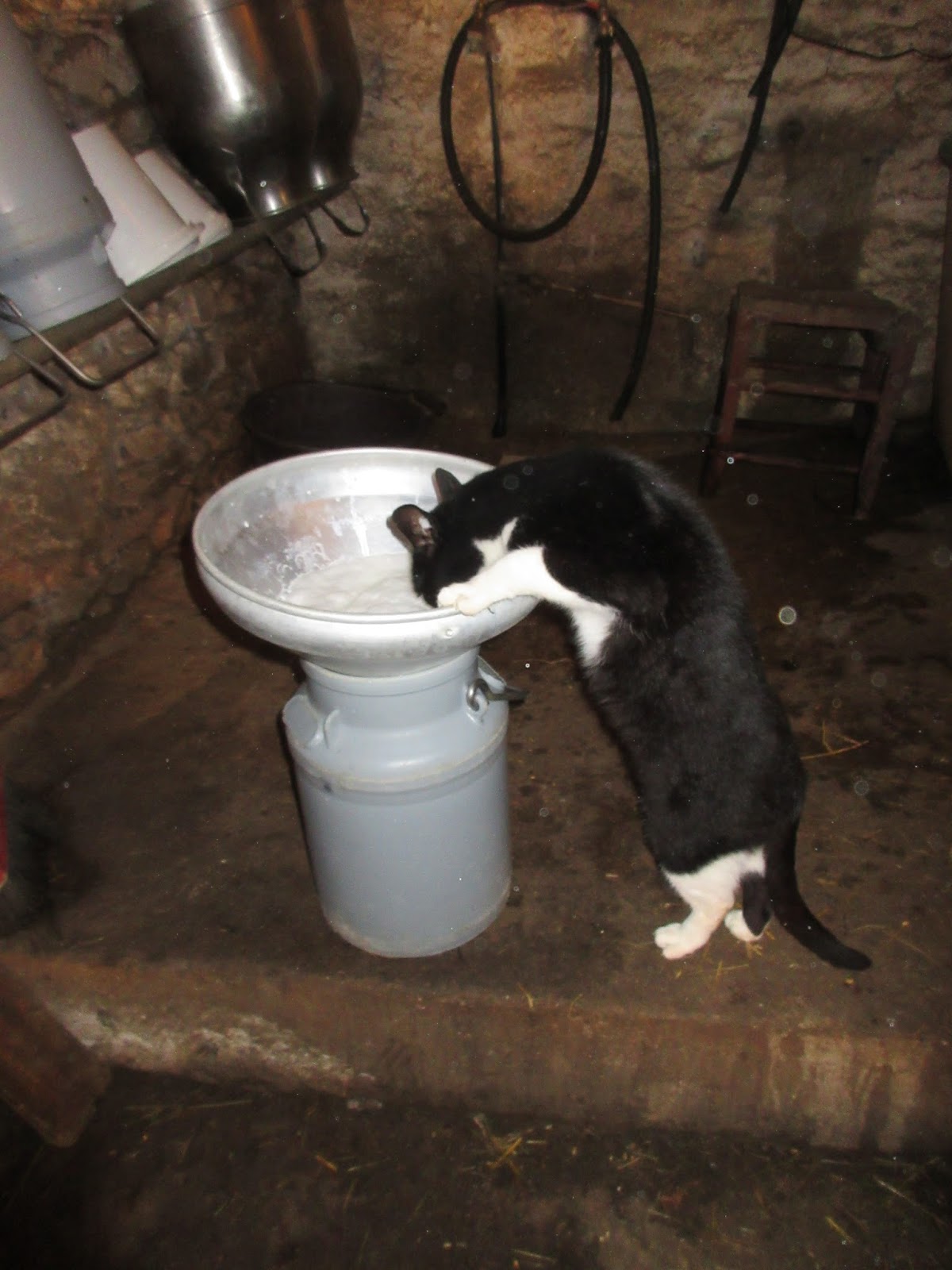
The black and white cat
always turns up for the milking.


3.  All about chestnuts

  • There are so many ways to eat chestnuts!  Roasted, toasted, in a sauce or tart, or in a confection . . . they're all good!
  • They've taught us learned this week how to roast, peel, pasteurize, and eat chestnuts.  Ingo has a machine that he fashioned from an older washing machine that does most of the hard work taking off the skins.  We just do the cleanup and cooking.
  • There's a running discussion about the difference between the marons and chartaignes (two different varieties of chestnuts).  Everyone agrees that the marons are cultivated, sweet, large and juicy.  Everyone also agrees that the chartaignes are the wild chestnuts that grow everywhere here.  But there are apparently many shades inbetween and nobody seems to agree on how you definitively discern if you're looking at a maron or chartaigne.

Ingo instructs a guy named
Guillaume who bought chestnuts from the farm
and plans to resell them, roasted to people at a market

Roasting our own test batch
in the large fireplace


Pasteurizing/Sterilizing Chestnuts
Carole and Guillaume
discuss how to best
prepare the chestnuts,
teaching us in the process


4.  How to harvest saffron

Saffron flowers
are pretty, aren't they?


5.  How amazing French food is made
  • Meals usually consist of some fabulous but simple French dish made with purchased meat and everything else harvested from the garden.  I'm taking notes. 
  • Because it's their specialty here, every meal has a cheese plate.  It's wonderful.
A cheese course at every meal - I'm in paradise.


The most interesting meal by far
was a nettles tart


Best. Pantry. Ever.

6.  How to harvest potatoes with donkeys
  • Yesterday afternoon, Ingo hooked up the donkeys and plowed the two long rows of potatoes in the garden for us girls to then lift from the softened earth.  Several of the neighbors joined in to learn how to work with these peaceful creatures.


7.  French and Catalonia history
  • Laura is a proud native Catalonian and is constantly comparing her native tongue with French, Spanish, and sometimes even Occitane.  During these discussions, I often get a dual lesson in language and history for both regions.  Laura told one story that I will repeat here: When she was 7 or 8 years old, there was a family from South America that moved to her town and there were several kids in her class that could not understand the newcomers [because they were speaking Spanish instead of Catalan].
  • Laura and I went hiking today since it was our day off - we passed an old glacier - a deep pit where they used to store snow and ice from the winter for use in the spring and summer.  There is now a cross inside it commemorating the farmers and their families laid there after the Nazis massacred everyone in the area as they pulled out of France.  
  • This whole region was apparently devoid of trees until the 60s when it was allowed to regenerate.  (A glass factory cut down all the trees to fuel the furnaces long ago.)  You would never know it to see the forests around this farm today.
A view from the Roquecave pastures
The glacier


8.  How to take it easy.  You learn to enjoy the simple pleasures here, like the sun on your face after 2 rainy days, a good meal and good conversation, the wind in the trees that are turning bright yellow and red, and the joy of finding the biggest chestnut ever under the leaves.  

The trees and vinyards are on fire with color
Plenty of chestnuts to go around

The cat is enjoying the sun too -
This one starts purring as soon as
you touch it


It's humbling to watch a family who has so little give so much.  They work all day, every day to make a life out of this farm.  Nothing is wasted.  Carole and Ingo have huge hearts.  On top of hosting people like me, they volunteer with children and show their neighbors how to farm and keep animals.  (They've been doing this for 30 years, and other folks in the area who would like to do small farming flock to them for expertise).  Carole even volunteered at a prison two days ago, showing them how to make cheese.  She was in a tizzy all morning to make sure she didn't forget anything, including enough cheese for the prisoners to take some back to their cells.   They also host 'neighborhood' events in this small mountain region - one neighbor taught a Yoga class on Monday and another neighbor taught traditional French dances on Thursday while 3 other neighbors alternately provided live accordion music.   I think these folks enjoy the small things more because they have less.  But they want for nothing.

Carole invited me to stay for another week, and I will gladly take her up on the offer.